










Growing a green future
04/12/2015Georgia Lala’s aquaponics system brings a new meaning to fish food.
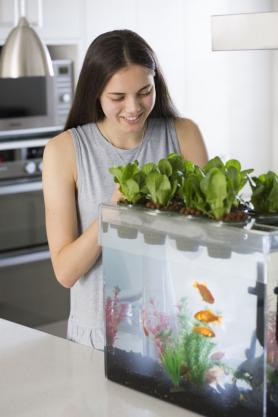 On the morning of 11 November 2015, Auckland student Georgia Lala was sitting her NCEA chemistry exam, and that afternoon she was shaking the Prime Minister’s hand.
The 18-year-old student was awarded the Future Scientist prize at the 2015 Prime Minister’s Science Prizes ceremony held at Te Papa Tongarewa.
The prize recognises Georgia’s work to develop an aquaponics system that utilises fish waste to allow food to be grown in the home.
Gleaning inspiration from an industrial-scale aquaponics system, Georgia realised the same principle could be used in a domestic setting to produce fresh salad greens and herbs.
“I had seen the system done before, but on a massive scale. My project was to take that idea and develop a small, household way to use it. I wanted to bring aquaponics to everyone, on a smaller scale,” she says.
Georgia’s system uses an ordinary fish tank with goldfish. The ammonia excreted by the fish is taken up by the roots of the plants set into the top of the tank, she explains.
“Aquaponics is a combination of hydroponics and aquaculture. Usually, if you keep goldfish, you’d need to clean out their tank regularly because the ammonia is toxic to them.
“With my aquaponics system, the plant life growing on top will take up the ammonia through its roots, so you don’t have to clean the fish tank, and the ammonia is beneficial to the plants at the same time.”
Georgia says the system has proved popular – she has patented the design, and promotes it at sustainability fairs and gardening expos.
“It’s a sustainable way to produce food – there are no pesticides or fertilisers. We have one in our kitchen right now, and it’s growing herbs at the moment that my mum uses for cooking.”
Both seeds and sprouts can be used when starting out.
“I’ve tried growing plants from seeds, and that worked well, but I’ve also started from seedlings. I’ve grown lettuces, rocket and spinach; leafy green vegetables seem to work best so far.”
When it comes to fish, Georgia believes goldfish are the best bet.
“I’ve found goldfish are the best to use with this system because they’re the most cost effective and easiest to care for. Many people keep goldfish or have in the past, so they’re familiar.”
In a world where food security is a great concern, Georgia’s system looks to the future.
“It means that essentially anyone can have a garden in their household. So someone who is living in an apartment with no outdoor space can still grow fresh things.”
The Prime Minister’s Future Scientist Prize sees Georgia $50,000 better off – a sum she says will support her through tertiary study.
“I’m doing biomedicine next year at Auckland University, and I hope to be able to go through to study medicine,” she says.
“I have actually always wanted to do that. I kind of knew from when I was 13 that I just really loved science. Medicine seemed like a natural progression from there.”
I have always had really cool science teachers at my school who had a real passion for their subject and made it fun to learn. I’ve been really lucky.”



Post your comment
Comments
No one has commented on this page yet.
RSS feed for comments on this page | RSS feed for all comments